
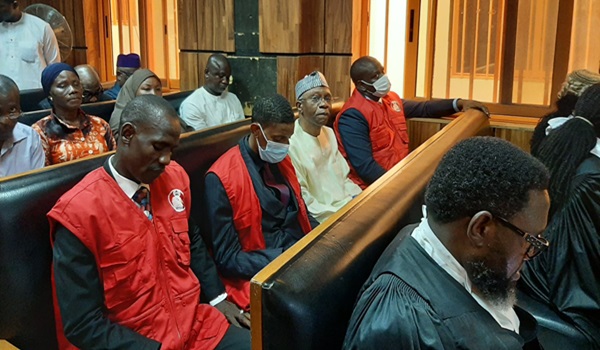
Justice Rahman Oshodi of the Lagos State Special Offences Court, Ikeja, on Thursday overruled objections by former Governor of the Central Bank of Nigeria (CBN), Godwin Emefiele, to the admissibility of extra-judicial statements he allegedly made to the Economic and Financial Crimes Commission (EFCC), holding that the statements are admissible in evidence.
In his ruling, Justice Oshodi held that Section 4 of the Anti-Torture Act, 2017, relied upon by Emefiele’s counsel, did not warrant a trial-within-trial to determine the admissibility of the statements.
The court agreed with the prosecution that a trial-within-trial was unnecessary because none of the statements sought to be tendered constituted a confession.
Justice Oshodi held that, for an extra-judicial statement to qualify as confessional, it must contain an unequivocal admission of the offences alleged against its maker.
According to the judge, nothing in Emefiele’s statements could be construed as an admission of the facts in issue.
The court consequently dismissed the defence’s objections and admitted as exhibits the statements allegedly made by Emefiele on October 27, October 30, November 11, November 12 and November 13, 2023.
Following the ruling, the court adjourned the case to October 6, 7 and 8, and November 11, 12 and 13, 2026, for the continuation of trial.
Emefiele is standing trial alongside Henry Omoile on a 19-count charge bordering on abuse of office, receiving gratification, accepting gifts through agents, corruption and fraudulent property transactions involving about $4.5 billion and ₦2.8 billion.
Omoile is facing a three-count charge of allegedly receiving unlawful gifts in connection with transactions involving the CBN.
Both defendants have pleaded not guilty to the charges preferred against them by the EFCC.
At the previous hearing, Emefiele’s lead counsel, Olalekan Ojo, SAN, urged the court to reject the statements, arguing that they were involuntarily obtained through oppression and torture while his client was detained by the Department of State Services (DSS) for more than 157 days.
Ojo contended that Emefiele was subjected to physical and psychological torture during his detention, rendering the statements inadmissible under Section 4 of the Anti-Torture Act, 2017, and the relevant provisions of the Evidence Act.
He maintained that once the voluntariness of a statement is challenged, the prosecution must establish that it was freely made, arguing that a video recording of the interrogation would have been the most reliable proof of compliance with due process.
According to the senior advocate, the absence of any video recording rendered the statements “poisoned fruits.”
He further argued that the prosecution failed to produce independent evidence corroborating the alleged confessional statements and questioned the role of the lawyer said to have witnessed the interviews.
Ojo urged the court to resolve any doubt regarding the voluntariness of the statements in favour of the accused and reject them.
Responding, the Director of Public Prosecutions of the Federation, Rotimi Oyedepo, SAN, argued that a trial-within-trial was unnecessary because none of the statements amounted to a confession or contained any admission of the facts in issue.
He further submitted that the Anti-Torture Act does not mandate a trial-within-trial in such circumstances and urged the court to dismiss the defence’s objections and allow the substantive trial to proceed.
Oyedepo maintained that there was no basis for conducting a trial-within-trial, insisting that none of the remaining statements constituted a confession.
“There is nothing in the defendant’s statements that can be construed as an admission of the facts in issue,” he submitted.
He further argued that the Anti-Torture Act does not make a trial-within-trial mandatory in the circumstances and urged the court to dismiss the defence’s objection and allow the substantive trial to proceed expeditiously.
